National Interrogation Center
The SympathizerThe National Interrogation Center is where the narrator learns and practices interrogation, and where the claimed science of extracting information collides with the institution’s use of confinement, sensory pressure, and violence. Its classrooms, cameras, and controlled rooms make interrogation appear methodical; its prisoners’ treatment reveals the cost of turning people into subjects of experiment and state security.
Training and institutional doctrine
Claude teaches a subterranean specialty course to twenty secret policemen, including the narrator, at the National Interrogation Center. The students are veterans of the army or police, but Claude’s authority still intimidates them. He rejects brute force as unreliable: pain, he argues, can produce lies, misdirection, or whatever answer a prisoner believes the interrogator wants. The tools gathered on his desk—a billy club, a plastic gasoline container repurposed for soapy water, pliers, and a hand-cranked electrical generator for a field telephone—are, in his account, less important than methods aimed at the mind. He teaches disorientation, sensory deprivation, and self-punishment as principles that can break a person down without leaving marks on the body.
The doctrine is presented as modern expertise, backed by American advisers and laboratory research. Yet its promise of precision does not mean an absence of coercion. The Center’s own work shows how a language of scientific technique can organize and legitimize the deliberate manipulation of prisoners, while leaving the interrogator responsible for how those techniques are used.
The white room and the narrator’s first assignment
Claude’s design for an all-white interrogation room makes the doctrine physical. The narrator has watched workmen build and paint it: the bed frame, desk, chair, bucket, dishes, soap, and the prisoner’s clothes are all white. Air conditioning holds the room at eighteen degrees Celsius, and overhead fluorescent lights never go out. White speakers are ready to play a sound selected to distress the prisoner. The blankness removes ordinary markers of time and space; the constant light and cold turn the room itself into an instrument of pressure.
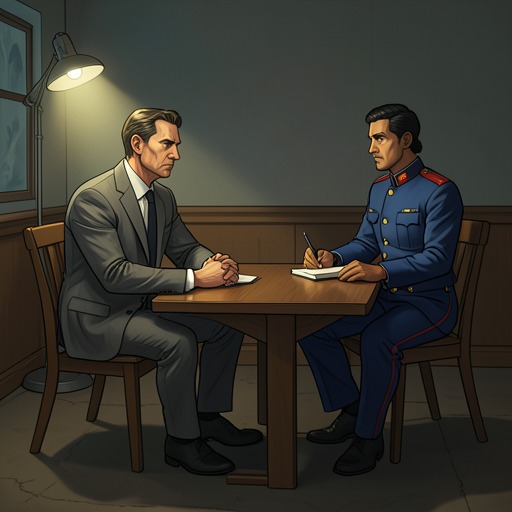
For his first assignment under Claude, the narrator is made chief interrogator and told to break the prisoner as his graduation examination. The prisoner is the leader of cell C-7 in Z-99, a unit based in a secret zone of Binh Duong Province and associated with hundreds of attacks and several thousand deaths. His specialty is adapting wristwatches into bomb timers: a battery wire passes through the watch crystal, and the minute hand completes the circuit when it reaches the set point. The Center keeps him in the room for a week before the narrator sees him in person. During that week, food enters through a slot three times daily: rice, one hundred grams of boiled greens, fifty grams of boiled meat, and twelve ounces of water. The narrator monitors the prisoner by camera as he eats, washes, exercises, paces, and tries to block out the music. When the prisoner plugs his ears, the narrator turns the volume up; when the man shouts at the cameras, Claude treats the fact that he is speaking as a useful sign.
The music is country music. The narrator selects Hank Williams’s Hey, Good Lookin’, obtained from a Saigon bar frequented by white soldiers, and orders it played in an endless loop except when he is inside the room. His explanation of the choice links the sound to American racial divisions and the exclusion signaled in those bars. The scene thus makes the room’s sensory assault more than a neutral technique: the interrogator chooses a sound he expects to be alienating, and the prisoner’s daily life becomes a controlled experiment administered by people watching from outside.
Practice beyond the classroom
The Center’s stated preference for mental pressure exists alongside more openly brutal forms of interrogation. In a later recollection, the narrator describes a room called the movie theater. When foreign visitors come, it serves as a theater; when they are absent, interrogations take place there. The room’s screen, projector, blackout curtains, and folding chairs can therefore stage a respectable public face while concealing what happens in private.
The narrator remembers being present with Claude and The crapulent major while three policemen interrogated a captured Communist agent. The agent had been caught with a list of police names concealed in her mouth; the narrator recognizes that his own name is on it and knows that he had passed the list to Man. He objects to what is happening and asks to be left alone with her, but the police carry out a sexual assault while the others watch. Claude distances himself from responsibility for the improvised abuse, saying he did not teach the policemen how to use a bottle as part of it. The scene exposes the gap between the Center’s instructional language and the conduct it tolerates: the institution’s personnel are not merely extracting information but inflicting violence, while responsibility is displaced among advisers, officers, and subordinates.
Recollection and significance
The Center returns in the narrator’s mind as he tries to understand what he has forgotten. Under questioning in the later reeducation camp, he recovers the movie-theater memory in fragments: the concealed interrogations, the policemen, The crapulent major, Claude, and the agent. His remembered presence is not that of an uninvolved observer. He watched, protested, and sought a limited chance to intervene, but did not stop the assault. The recollection makes the Center a source of personal as well as institutional history, binding the narrator to the methods he learned and the violence he witnessed.
The institution’s contrast between scientific instruction and coercive practice is therefore central to its portrayal. Claude’s lessons distinguish interrogation from punishment and prize tailored psychological pressure; the white room demonstrates how that pressure is engineered, while the movie theater reveals violence hidden behind an ordinary public function. Together, these spaces show the Center’s power to shape both what prisoners endure and what its personnel can later claim, remember, or try to confess.